The use of specific gems as "birthstones for a specific month" and wearing them in jewelry is a custom that began in eighteenth-century Europe and quickly spread to the United States.The practice became popular in the United States, and in 1912, the American National Retail Jeweler’s Association (now named Jewelers of America) adopted a standardized list of monthly birthstones which went into use by jewelers throughout the country. Birthstone jewelry is still very popular in the United States.

Birthstone Hardness and Durability
Gems vary in hardness and durability. Below we have rated the birthstones according to their suitability for use in various types of jewelry, giving them ratings from "poor" to "excellent". The ratings below apply only to natural gems. If you are considering a synthetic birthstone, they generally rate between good and excellent, but a consultation with a jeweler can determine if they are suitable for your intended use.
Excellent: The most durable birthstones are diamond (April), ruby (July), and sapphire (September). All of these gems have hardness of 9 or 10, excellent durability, and are suitable for any use in jewelry.
Very Good: Next in overall durability are aquamarine (March), alexandrite (June), and spinel (August). They have a hardness of at least 7.5 and very good durability. These gems are also suited for use in any type of jewelry.
Good: A number of gems are durable enough for use in any type of jewelry. However, because of their hardness they are subject to being scratched or abraded. If they are used in a ring or a bracelet, a mounting that protects them from impact and abrasion is a good idea, as is removing the jewelry during activities that might result in damage. These gems are garnet (January), amethyst (February), bloodstone (March), sardonyx (August), tourmaline (October), and citrine (November).
Fair to Poor: Gems rated less than good have some defecit that makes them vulnerable to breakage or abrasion. Emerald (May), opal (October), peridot (August), and zircon (December) are all prone to breakage. Moonstone (June), topaz (November), and tanzanite (December) all have perfect cleavage and will break easily. Pearl (June), opal (October), and turquoise (December) all have a low hardness and are easily scratched.
Mohs Hardness of Birthstones | |||
| Month | Gemstone | Mohs Hardness | Durability |
| January | Garnet | 6.5 to 7.5 | Good |
| February | Amethyst | 7 | Good |
| March | Aquamarine Bloodstone | 7.5 to 8 6.5 to 7 | Very Good Good |
| April | Diamond | 10 | Excellent |
| May | Emerald | 7.5 to 8 | Fair |
| June | Pearl Alexandrite Moonstone | 2.5 to 4.5 8.5 6 to 6.5 | Poor Very Good Poor |
| July | Ruby | 9 | Excellent |
| August | Peridot Spinel Sardonyx | 6.5 to 7 7.5 to 8 7 | Fair Very Good Good |
| September | Sapphire | 9 | Excellent |
| October | Opal Tourmaline | 5.5 to 6 7 to 7.5 | Poor Good |
| November | Topaz Citrine | 8 7 | Poor Good |
| December | Turquoise Zircon Tanzanite | 5 to 6 6 to 7.5 6.5 | Poor Fair |
1. January Birthstone: Garnet |
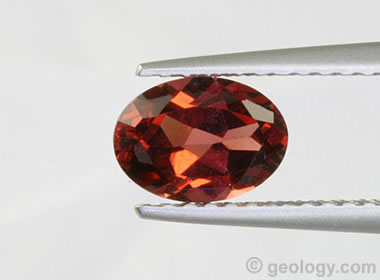
Garnet
Garnet is the birthstone of January. Although many people think of a red gem when they think of garnet, it is actually available in almost every color - green (tsavorite and demantoid), orange (spessartine and hessionite), purple (rhodolite), yellow (mali and topazolite), pink (malaya), red (almandine and pyrope), black (melanite). These are just some of garnet's many colors and varieties. There are even opaque garnets that are usually cut as a cabochon (pink hydrogrossular and green grossularite). The color variety of garnet gives people born in January many color options.
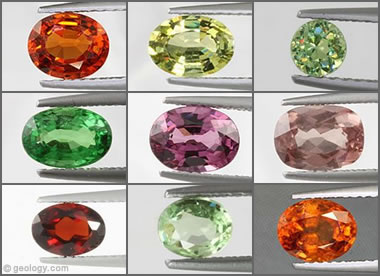
The accompanying photo shows some of the many different colors in which garnet can occur. Top row, from left to right: orange spessartite (Mozambique), yellow mali (Mali), green demantoid (Namibia). Middle row: green tsavorite (Tanzania), purple rhodolite (Mozambique), pink malaya (Tanzania). Bottom row: red pyrope (Cote d'Ivoire), green merelani mint (Tanzania), orange hessonite (Sri Lanka). Except for the orange hessonite from Sri Lanka, all of these garnets were mined in Africa, the relatively new source of spectacular garnets.
2. February Birthstone: Amethyst |
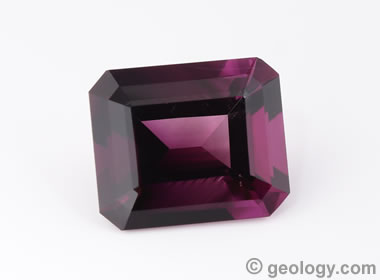
Amethyst
Amethyst is the birthstone for February. It is the world's most popular purple gem - and that enhances its status as a birthstone. The purple color of amethyst can be so light that it is barely perceptible, or so dark that a faceted gem can be nearly opaque. The color of amethyst spans a range from violetish purple, to purple, to reddish purple. The gem shown here is a beautiful reddish purple amethyst from the Four Peaks Mine in Maricopa County, Arizona. Four Peaks is the most important amethyst mine in the United States.
3. March Birthstones: Aquamarine and Bloodstone |
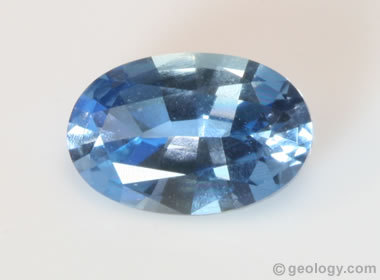
Aquamarine
Aquamarine is the the birthstone for the month of March. Aquamarine is the blue variety of the mineral known as beryl. It occurs in a range of colors from slightly greenish blue to a nearly pure blue hue.Aquamarine also occurs in a range of color saturations, from a very light, almost imperceptible blue to a rich deep blue. The richly colored aquamarines with the purest blue color are most popular. Many people enjoy the light-colored stones which are much more affordable.
Bloodstone
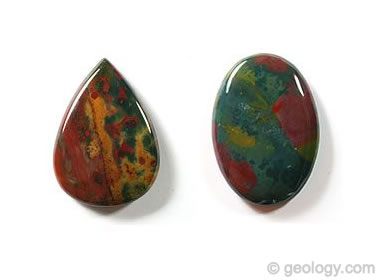
Bloodstone is another gem that serves as a birthstone for March. It is an opaque green chalcedony that is marked with splashes of red and often other colors. Bloodstone receives its name from the red splashes of blood-like color. As an opaque gem, bloodstone is usually cut into dome or shield-shaped gems known as cabochons. It has been a popular gemstone for at least two thousand years. In Europe and in older publications bloodstone is known by the name "heliotrope". Bloodstone is a popular and durable gem for men's rings, cufflinks, and tie tacks.4. April Birthstone: Diamond |
Diamond
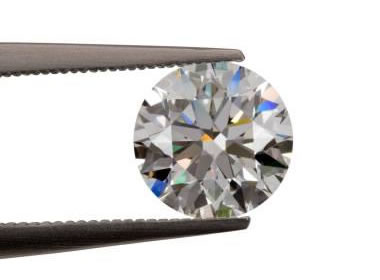
Diamond is the birthstone of April. It is the world's most popular gem. Many people enjoy diamond because of its brilliance and because of its dispersion. Dispersion is the ability of a gem to act as a prism and separate light into its component colors - as shown by the diamond in the accompanying photo.Diamond is one of the most expensive birthstones. When cost is a concern, many people opt for a smaller stone. Others decide to purchase a more affordable lab-grown diamond. If cost is not an issue, then a beautiful colored diamond might be possible! Image copyright iStockphoto / Greg Stanfield.
5. May Birthstone: Emerald |
Emerald
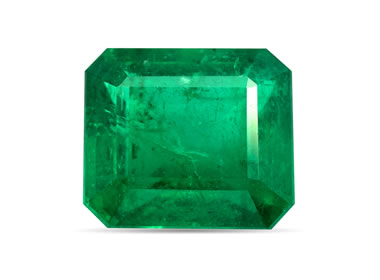
Emerald is the birthstone for the month of May. It is the world's most popular green gem. It is the green variety of the mineral beryl. Emeralds range in color from slightly yellowish green, to pure green, to slightly bluish green. Pure green emeralds are the most popular and valuable.Emerald can be a costly gem, and it often lacks the high level of clarity that many people desire. For that reason, lab-grown emeralds have become a popular option in birthstone jewelry. Lab-grown emeralds can be purchased at a small fraction of the cost of a natural emerald of similar size, color, and clarity. The buyer and the recipient of an emerald birthstone gift might be pleased with this option. Image copyright iStockphoto / mikheewnik.
6. June Birthstones: Pearl, Alexandrite, and Moonstone |
Pearl
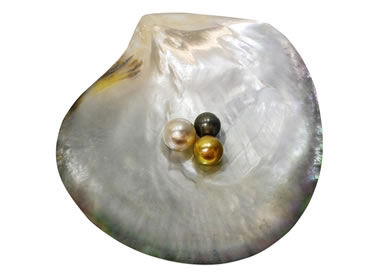
Pearl is an organic gem and the traditional birthstone for the month of June. There are three basic types of pearls: 1) natural pearls, which form naturally within the shell of a living mollusk; 2) cultured pearls, which are propagated by people by inserting a "seed" into a mollusk shell with the intent that the mollusk will deposit layers of nacre around it; and, 3) imitation pearls, which are usually plastic beads with a lustrous coating applied. Most pearls in today's market are cultured pearls, which are very affordable when compared to natural pearls, and make a much nicer gift than imitation pearls. Most jewelry stores sell pearl jewelry, most often with cultured pearls. The pearls in the photo are a white South Sea pearl, a black Tahitian pearl, and a gold South Sea pearl. Image copyright iStockphoto / barbaraaaa.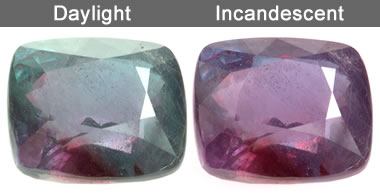
Alexandrite
Alexandrite is a color-change variety of chrysoberyl that appears as different colors under daylight and incandescent illumination. Pictured here is a faceted specimen of color-change alexandrite of 26.75 carats from Tanzania, showing a blue-green color in daylight and a purple-red color under incandescent light. Natural alexandrite of good color and clarity is an extremely expensive gem, however, lab-created alexandrite can be found in many jewelry stores. Some of the lab-grown alexandrite has a spectacular appearance! Photo by David Weinberg for Alexandrite.net and published here under a GNU Free Document License.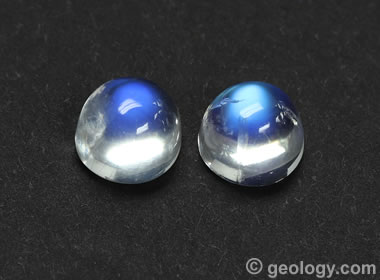
Moonstone
Moonstone is a feldsparmineral that produces a "pearly" luster when light enters the stone and is reflected by mineral layers within the gem. Moonstone is most often a white or gray color with a glow that is white or silvery - like the glow of the moon (that's how it got its name!). Moonstone also occurs in pink, orange, near-colorless and other colors. Rare moonstones produce a blue or a multicolored glow. These are called "rainbow moonstones" and they are market favorites. The accompanying photo shows two cabochons of rainbow moonstone with a bright blue glow.7. July Birthstone: Ruby |
Ruby
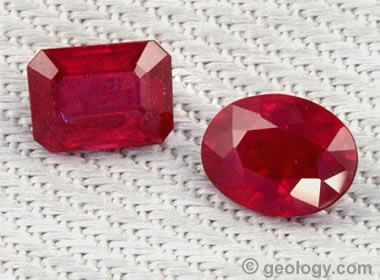
Ruby is the birthstone for the month of July and the world's most popular red gem. Rubies range in color from orangy-red, to red, to slightly purplish-red. The most desirable and valuable colors are pure red and slightly purplish red. Natural rubies have historically been expensive gems, but recent discoveries in Africa bring many attractive natural rubies into the market at affordable prices.Lab-grown ruby is very common in jewelry stores in the United States. Lab-grown rubies have been in the United States jewelry market since the early 1900s. Today, if you go to a mall jewelry store such as Zales or Kay Jewelers, you will encounter a case with a large assortment of ruby jewelry items for sale. Many of them will likely be synthetic or lab-grown ruby. If you spend time studying them, you might note that the synthetic gems usually have better clarity and better color than natural gems of similar price. Many people are happy to pay the higher price for natural gems because they treasure gems that formed naturally within the Earth. Others are happy with the great appearance and lower price of lab-created gems.
8. August Birthstones: Peridot, Spinel, and Sardonyx |
Peridot
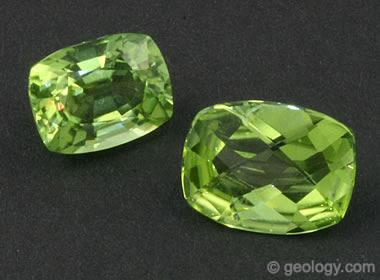
Peridot is a traditional birthstone for the month of August. It has a yellowish green color and is one of the world's most popular and affordable green gems. Shoppers can expect to find it in almost every jewelry store.Peridot is the gem variety of a mineral group known as olivine. Much of the world's peridot is found in basalt flows. Basalt is an igneous rock that solidified from lavas erupted from volcanoes. The green sand beaches of Hawaii contain peridot crystals weathered from basalt. Some peridot falls to Earth in meteorites.
Spinel
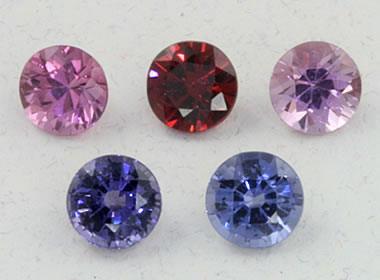
Spinel is a mineral that occurs in a wide variety of colors. It occurs in a rich red color that looks like ruby. It occurs in a nice blue color that looks like sapphire. It occurs in many other colors as well. Spinel was a late addition to the modern birthstone lists in 2016. Perhaps the makers of these lists wanted to give people born in August a wider variety of color choices.Spinel is a very hard and durable gem. It has a Mohs hardness of 7.5 to 8. Diamond, ruby, sapphire, and topaz are the only widely-used gem materials with a higher hardness.
Sardonyx
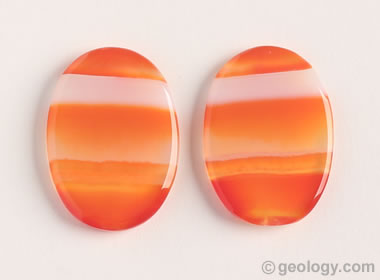
Some (but not all) birthstone lists include sardonyx as a birthstone for August. Sardonyx is a banded variety of chalcedony that exhibits straight, parallel bands of white, black, orange, red, or brown chalcedony. Some of the most spectacular cabochons and beads are cut from sardonyx.Sardonyx has also been used as a material for cutting cameos. These take advantage of the layered, multicolored nature of the material. Cameos have been popular in jewelry for at least 2000 years. (Cameos are often cut from many other materials, especially shell materials, but many of the finest cameos are cut from sardonyx.)
9. September Birthstone: Sapphire |
Sapphire
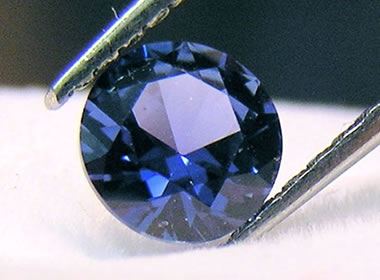
Sapphire is the birthstone for September. Most people immediately think of a blue gem when they hear the name "sapphire". That is because gem-quality specimens of the mineral corundum with a blue color are called "sapphire" by definition. However, corundum occurs in many colors. When it is pink, orange, green, purple, yellow, or any of these other colors, the name "fancy sapphire" is used.Some of the world's finest sapphires have been mined in a Montana locality known as Yogo Gulch. If you know someone with a September birthday who lives in Montana, a Yogo sapphire might be the perfect birthstone gift. Creative Commons photo of a gem from Barnes Jewelry, Helena, Montana, by Montanabw.
10. October Birthstones: Opal and Tourmaline |
Opal
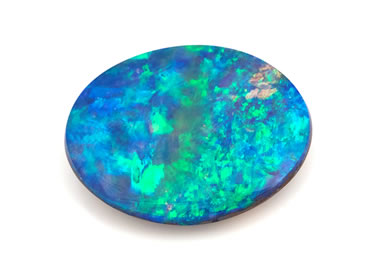
Opal is an original modern birthstone for the month of October. Some people call it the world's most colorful gem because one stone can display a full spectrum of colors. Opal occurs many different varieties. The accompanying image is a black opal from Australia, but there are also fire opals from Mexico, honeycomb opals from Ethiopia, and colorful common opals from Peru. Lab-grown opals are available in a wide variety of colors and appearances for people who would like to obtain an attractive item for a lower price. Lab-grown opals are being sold today in many jewelry stores. Image copyright iStockphoto / mikheewnik.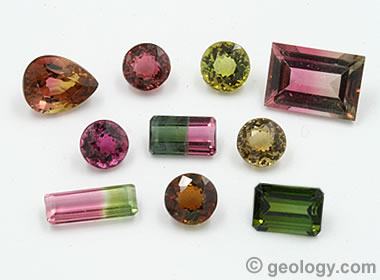
Tourmaline
Tourmaline occurs in a wide variety of colors. The accompanying photo shows a collection of faceted tourmalines of various colors. Some of these stones exhibit multiple colors because they were cut from color-zoned crystals. Two are pink and green bicolor stones known as "watermelon tourmaline." Bicolor and pleochroic tourmalines are favorite stones of many jewelry designers because they can be used to make especially interesting pieces of jewelry.Tourmaline is not an original birthstone for October. It was added to most birthstone lists in 1952. Some lists specify "pink tourmaline" for people born in October. Tourmaline gives people born in October the option of a colorful faceted stone and a stone more durable than opal.
11. November Birthstones: Topaz and Citrine |
Topaz
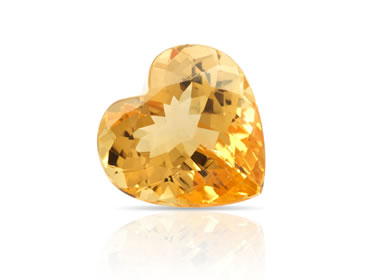
Topaz is a birthstone for the month of November. It occurs in a wide range of natural and treated colors that include blue, pink, purple, yellow, brown, orange, and colorless. Topaz is a very durable stone with a Mohs hardness of 8. Diamond, ruby and sapphire are the only commonly used gemstones with a greater hardness.The most popular color of topaz sold in jewelry today is blue. Natural blue topaz exists but it is very rare and very expensive. Fortunately for people born in November who like blue, colorless topaz can be treated with irradiation and heat to produce a variety of blue colors. Swiss blue and London blue are two of the most popular blue colors in treated topaz. Topaz is also coated to produce a range of iridescent colors and stones that appear to change color depending upon the angle at which they are viewed. These coated stones are called "mystic topaz". Image copyright iStockphoto / mikheewnik.
Citrine
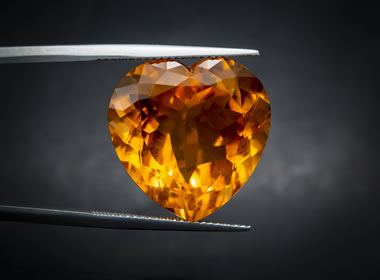
Citrine is the world's best-selling gem with a yellow to orange color. It is a favorite gem because of its affordability and durability. It is durable because of its Mohs hardness of 7 and affordable because of its abundance.Citrine is not as easy to find in jewelry stores as blue topaz, but with a little searching you should be able to find it. Citrine is not an original modern birthstone for November. It was added to most birthstone lists in 1952. At that time topaz was a relatively costly gem, but the discovery of large deposits in Brazil have greatly reduced the price of topaz. Most citrine also comes from Brazil. Image copyright iStockphoto / wirachai moontha.
12. December Birthstones: Turquoise, Zircon, and Tanzanite |
Turquoise
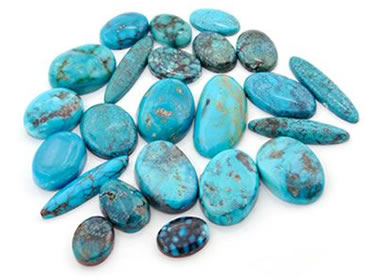
Turquoise is a birthstone for the month of December. It is a blue to blue green to yellowish green mineral that has been used as a gemstone for thousands of years. Bright blue turquoise is the most preferred color. It is most often set into sterling silver jewelry. Because it is opaque, it is usually cut into cabochon shapes, often freeform to take full advantage of the rough, instead of being cut into calibrated shapes and sizes.In the southwestern United States, Native Americans were using turquoise over 2000 years ago. There, ancient artists produced beads, pendants, inlay work, and small sculptures. Turquoise is still an important part of Southwestern culture.
Turquoise jewelry is not extremely expensive. Many people can afford to purchase genuine turquoise, but lab-created turquoise is available in some stores for cost-conscious shoppers. Image copyright iStockphoto / IrisGD.
Zircon
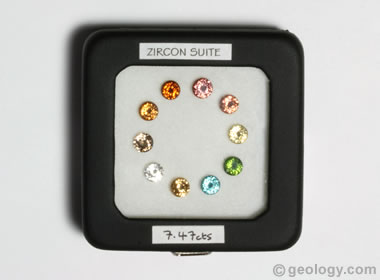
Zircon is another gem that serves as a birthstone for the month of December. It is a bright gem with high luster, and many specimens produce a colorful fire that is similar to diamond. Because of these properties, zircon was once used as an alternative stone for diamond.Zircon gives the shopper an opportunity to select from a variety of colors. Blue is the most popular zircon color. Most natural zircons are yellow, red or brown, but heat and irradiation treatments can transform them into blue, green and many other colors. About 80% of the zircons sold today are blue, with the color produced by treatment. Zircon replaced lapis lazuli as a modern birthstone in 1952.
Tanzanite
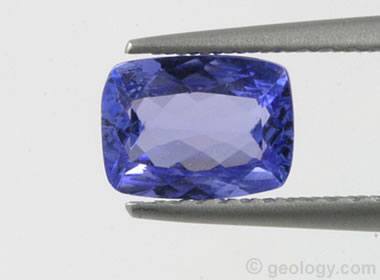
Tanzanite is the newest birthstone for the month of December. Most tanzanite sold in jewelry today has a blue to bluish purple to bluish violet color that is produced by heat treatment. Its color has an interesting feature - it changes depending upon the angle of viewing. If you have tanzanite jewelry, look at the stone face up and then from the side - you might be able to notice a slight color difference.Tanzanite was added as a modern birthstone in 2002. "Tanzanite" is a trade name that was first used by Tiffany and Company for gem-quality specimens of the mineral zoisite with a blue color. The gem was first discovered in the 1960s in the country of Tanzania, and that is the origin of the gem's name. Shown here is a violet-blue tanzanite measuring 7 x 5 x 3 millimeters in size and weighing 1.02 carats, antique facet cut. This grade of tanzanite is often seen in mall and chain store


